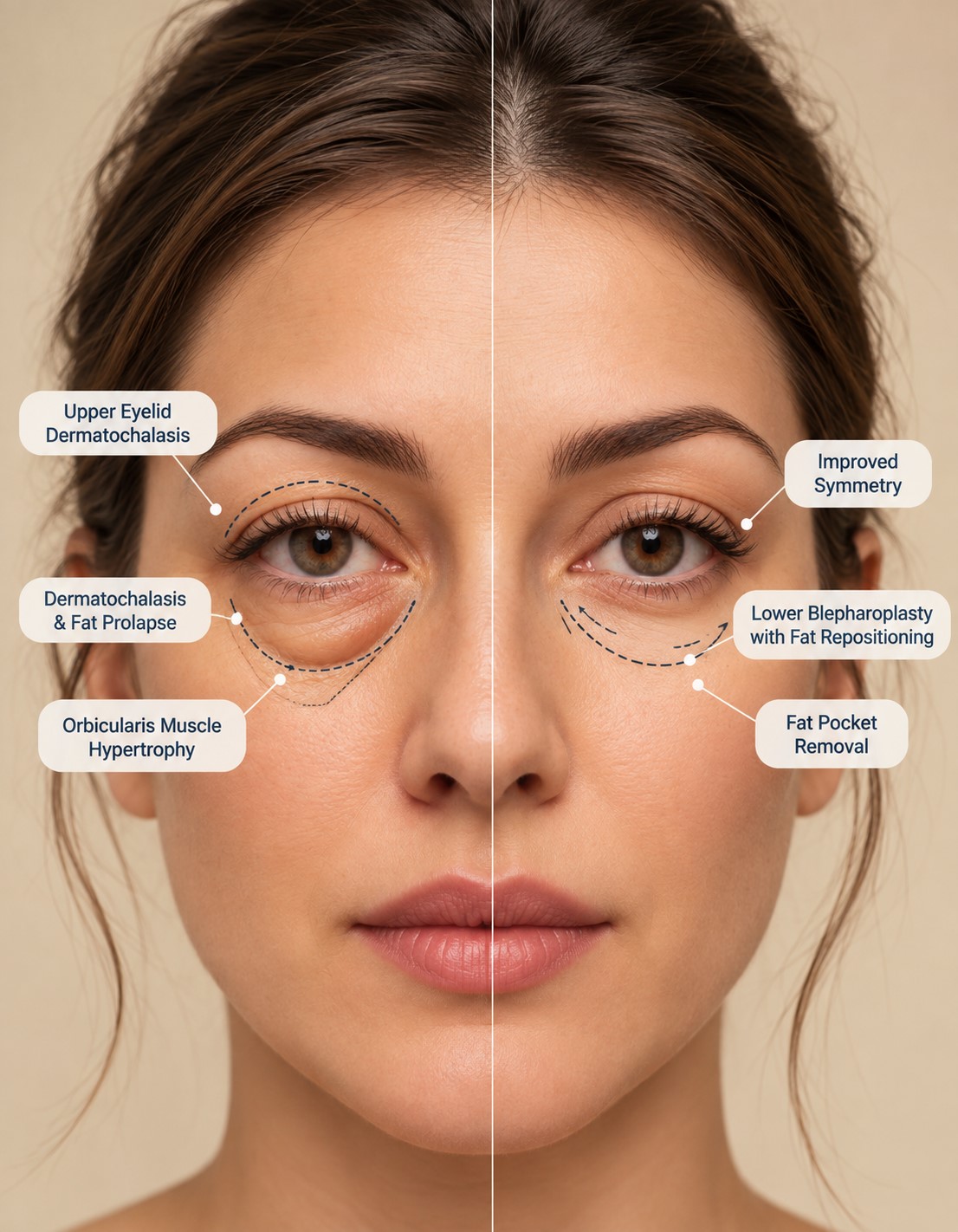
Refresh the appearance of the lower eyelids with a personalised surgical approach that addresses under-eye bags, excess skin, and selected changes in lower eyelid volume and contour.
Lower blepharoplasty is a surgical procedure that improves the appearance of the lower eyelids by addressing excess skin, under-eye fat, and changes in lower eyelid contour.
Ageing can cause the skin beneath the eyes to loosen and orbital fat to become more prominent. These changes may create under-eye bags, hollows, or a tired appearance.
Your surgeon selects the surgical approach according to your lower eyelid anatomy, skin quality, fat distribution, and individual goals. The procedure may remove, reposition, or preserve selected tissues to create a balanced result.
The goal is to improve under-eye contour while respecting your natural facial structure.
Lower blepharoplasty may suit adults who want to address visible changes around the lower eyelids and have realistic expectations about surgery and recovery.
You have prominent lower eyelid fat that creates a persistent under-eye bag or fullness.
You have loose or redundant skin beneath the eyes that affects the lower eyelid contour.
You have tear-trough or lower eyelid hollowing that may benefit from carefully planned volume treatment.
Your surgeon can assess your eye surface, tear film, eyelid position, and other factors before surgery.
You understand that surgery can improve selected concerns but cannot stop natural ageing or guarantee perfection.
You have specific concerns about your lower eyelids and want a treatment plan tailored to your anatomy.
Your surgeon will evaluate your lower eyelid structure, skin quality, fat distribution, eyelid support, eye health, and treatment goals before recommending surgery.
Your surgeon selects the technique according to your lower eyelid anatomy, skin quality, fat distribution, eyelid support, and treatment goals.
This approach uses an incision inside the lower eyelid. It can suit patients with prominent under-eye fat and limited excess skin.
This approach uses an incision near the lower lash line. It can allow the surgeon to address excess skin and selected deeper tissues.
The surgeon may reposition selected orbital fat toward areas of hollowing to create a smoother transition between the lower eyelid and cheek.
Preserving appropriate fat volume can help avoid an overly hollow appearance and maintain a balanced lower eyelid contour.
Canthopexy or canthoplasty may help address lower eyelid laxity when the surgeon considers additional support appropriate.
Selected patients may benefit from fat grafting or additional skin treatments to address hollows, texture, or surface concerns.
There is no single technique that suits every patient. Your surgeon will choose the approach and tissue treatment that best matches your anatomy and goals.
Lower blepharoplasty can address selected changes around the lower eyelids and create a smoother, more balanced transition between the eyes and cheeks.
The procedure can address prominent lower eyelid fat that contributes to a puffy or tired appearance.
Careful treatment of excess skin and selected tissues can create a smoother lower eyelid contour.
Fat repositioning or volume treatment may soften the transition between the lower eyelid and upper cheek.
Selected patients may benefit from removing limited excess lower eyelid skin when laxity contributes to their concerns.
A personalised approach can improve the relationship between the lower eyelids, cheeks, and surrounding facial features.
Thoughtful tissue preservation and conservative correction can support a refreshed appearance without excessive hollowing.
The benefits you may achieve depend on your anatomy, skin quality, eyelid support, tissue characteristics, surgical technique, and healing response.
Your surgeon plans each stage around your lower eyelid anatomy, skin quality, fat distribution, eyelid support, and treatment goals.
Your surgeon evaluates the lower eyelids, skin, fat distribution, eyelid support, eye health, and facial proportions before selecting the surgical approach.
The surgical team prepares the treatment area and provides the anaesthesia plan selected for your procedure.
Your surgeon chooses a transconjunctival or transcutaneous approach based on your anatomy and whether the procedure needs to address excess skin.
The surgeon may preserve, remove, or reposition selected orbital fat to improve under-eye fullness and the transition between the eyelid and cheek.
When appropriate, your surgeon addresses limited excess skin and may add eyelid support techniques to improve lower eyelid position and stability.
Your surgeon closes the incision carefully and protects the treated area as you begin your recovery.
The exact surgical steps vary between patients. Your surgeon will determine the appropriate approach after assessing your lower eyelids and individual needs.
Recovery from lower blepharoplasty varies between patients. Swelling and bruising usually improve gradually as the tissues heal and the lower eyelid contour settles.
Swelling, bruising, tightness, and mild discomfort can occur around the eyes. Cold compresses and prescribed eye care may help during this early stage.
Bruising and swelling usually begin to settle. Your surgeon may review your healing and remove non-absorbable sutures when appropriate.
Most visible swelling continues to decrease, while the lower eyelid contour gradually becomes more refined.
Subtle swelling and tissue changes can continue to settle over the following months as the eyelids complete their healing process.
Lower blepharoplasty can create a smoother and more balanced appearance around the eyes when the procedure matches your anatomy and treatment goals.
Do not judge your final result during the early recovery period. Healing varies according to the surgical technique, tissue characteristics, and individual recovery response.
Before-and-after photographs can help illustrate the changes lower blepharoplasty may achieve. Each result depends on your anatomy, skin quality, tissue characteristics, surgical technique, and healing.
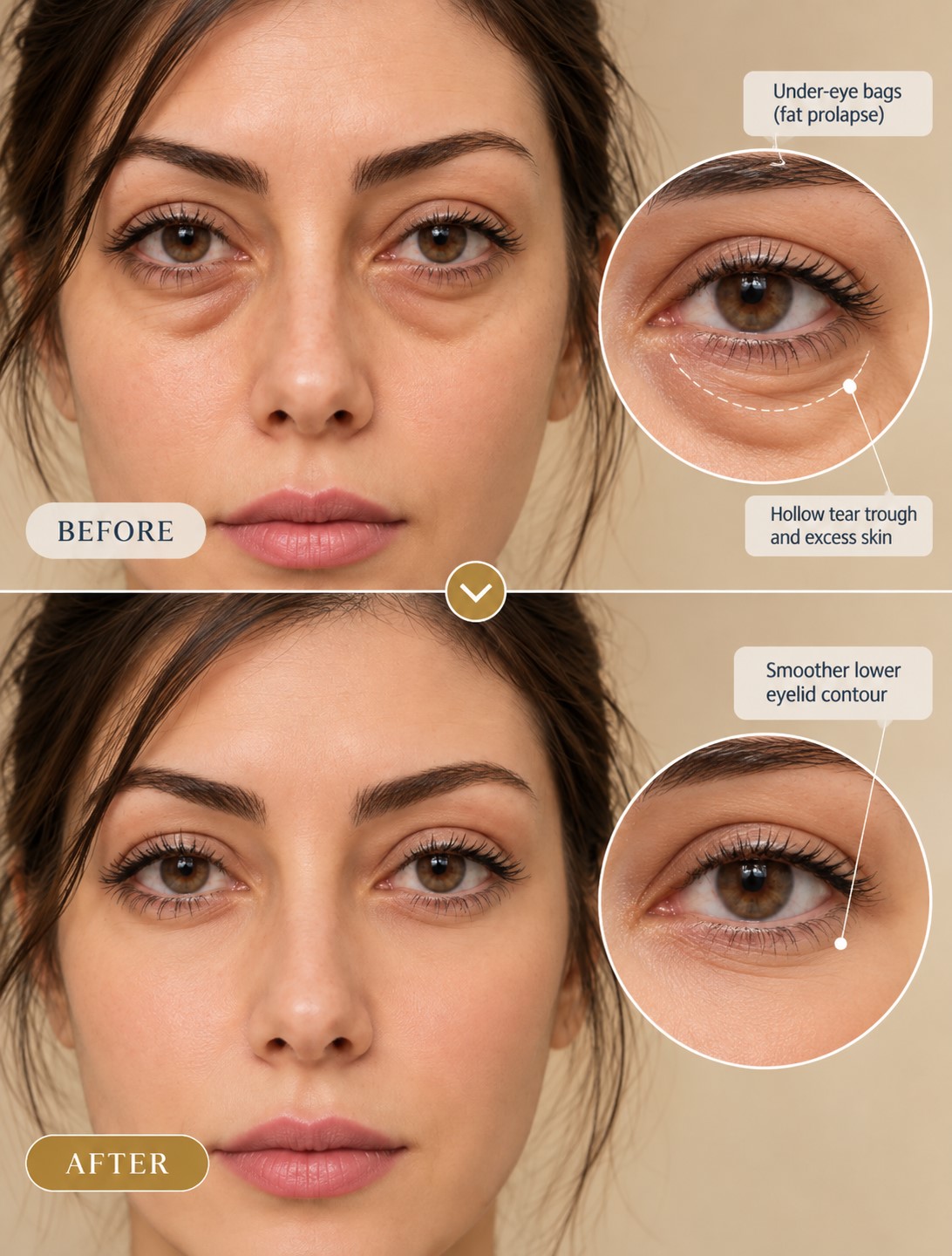
Lower blepharoplasty can address selected under-eye bags, excess skin, and contour irregularities while maintaining natural facial proportions.
Your surgeon will assess your lower eyelid anatomy, fat distribution, skin quality, eyelid support, and goals before recommending the most appropriate approach.
Evaluate the lower eyelids, surrounding tissues, and individual concerns.
Select a surgical approach based on anatomy, tissue quality, and treatment goals.
Focus on smoother contours, balanced proportions, and natural-looking improvement.
Before-and-after images represent individual patient outcomes and do not guarantee a specific result. Healing and final appearance vary from person to person.
Find answers to common questions about lower blepharoplasty, including candidacy, techniques, recovery, results, and potential risks.
Lower blepharoplasty is surgery that addresses selected changes around the lower eyelids, such as excess skin, prominent fat, and contour irregularities. The surgeon tailors the approach to your anatomy and goals.
Adults with concerns such as under-eye bags, excess lower eyelid skin, or selected contour changes may be candidates. A surgeon should assess your eye health, eyelid support, anatomy, and expectations before recommending surgery.
Common approaches include transconjunctival and transcutaneous techniques. Your surgeon may also preserve or reposition fat and add eyelid support or volume treatment when appropriate.
A transconjunctival approach uses an incision inside the lower eyelid and can suit patients with prominent fat and limited skin excess. A transcutaneous approach uses an incision near the lower lash line and can address excess skin as well as deeper tissues.
Lower blepharoplasty can address prominent under-eye fat that contributes to bags. Depending on your anatomy, the surgeon may remove, preserve, or reposition selected fat rather than simply removing all excess tissue.
It can address some contour changes around the tear trough and lid-cheek junction. Fat repositioning or additional volume treatment may help selected patients, depending on their anatomy and goals.
No. Surgeons generally remove excess skin conservatively when skin excision is appropriate. Removing too much skin can affect lower eyelid position and function.
Swelling and bruising usually improve during the first weeks, but subtle swelling can take longer to settle. Your recovery time depends on the surgical technique, extent of treatment, and individual healing response.
You may notice improvement as early swelling decreases, but the lower eyelid contour continues to settle during healing. Your surgeon can provide a more specific timeline based on your procedure and recovery.
A transconjunctival approach places the incision inside the lower eyelid. A transcutaneous approach places the incision near the lower lash line, where the scar can become less noticeable as it heals.
Risks can include bruising, swelling, dry eyes, asymmetry, under- or overcorrection, lower eyelid retraction, ectropion, and other complications. Rare complications can affect vision and require urgent treatment.
Lower blepharoplasty may be combined with procedures such as brow or facial surgery, or selected volume and skin treatments. Your surgeon will determine whether combining procedures is appropriate for you.
Every treatment plan starts with a detailed assessment of your lower eyelids, facial anatomy, goals, and individual needs.
Book Your Consultation →Contact our team to discuss your goals, receive your personalized treatment plan, and begin your journey to Istanbul with confidence.